
“A pen is mightier than a sword,” Cardinal Richelieu once said to the British writer and politician Edward Bulver-Leighton (Edward Bulwer-Lytton) in a play written in 1839 “Richelieu; or conspiracy”. The metaphor fits well into the theme of “communication in the military industry.”
Reputation and fame are the most valuable intangible assets that any organization owns. Any company that has ever faced reputational risks or has even been forced to trigger crisis communication mechanisms knows this. However, for companies in the military and defense sectors, the risk of losing their reputation can be particularly critical - public suspicions are enough for a long-drawn deal to disappear without a trace.
Quod licet Iovi, non licet bovi1
The defense and military industries operate in an environment characterized by high public scrutiny, political sensitivity, and national security considerations. Unlike commercial sectors, military and defense authorities need to communicate effectively with their target audiences while protecting classified information. In this context, communication is an essential tool for maintaining legitimacy, responsibility and strategic coherence - not forgiving in the military industry what could possibly be forgiven in civilian sectors. Unsuccessful examples of reputation management are not far to look for.
At the beginning of this year, the purchase of 22.8 million anti-tank mines in Lithuania was discontinued. In it, the company “Eksplosita” was recognized as the winner. Although none of the responsible bodies acting in the procurement commission found any legal grounds for excluding the tenderer from the tender, the reason for the decision to cancel the contract was the public information that only one person was officially employed in the company (which in itself is not reprehensible, especially if the company is part of a larger holding company) share), while the current leader of the ruling Social Democratic Party, Mindaugas Sinkečicius, was once involved in the chain of shareholders.2 It all started with a single entry on platform “X”, and the domino dice began to fall.
Giants also need to prove themselves or the risks can be also political
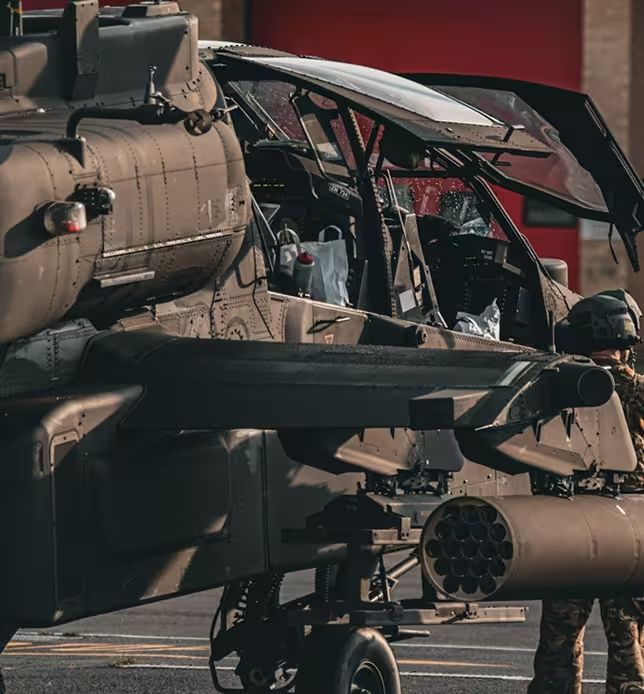
In 2015, the Polish government signed a contract worth 3.5 billion with European aviation giant Airbus for 50 H225M Caracal purchase of helicopters. At the end of the same year, elections to the Seimas (parliament) were held in Poland, in which the previous opposition, the right-wing "Law and Justice party" won, and undertook to revise the agreements concluded earlier. They also did so and decided to terminate the contract with Airbus and to make deliveries from the US company Lockheed Martin, and instead of Caracal ordered Black Hawk Helicopters. The newly elected government justified this by the existence of a branch of the US company in Poland, the Sikorsky Helicopter Plant.3
The situation created not only a commercial, but also a diplomatic scandal between Poland and France, one of the owners of Airbus shares. The problem was smoothed out after only six years, with Poland paying $20 million in compensation for breaking the contract with Airbus, which, of course, was a negligible amount compared to the previously concluded and canceled multi-billion dollar contract.
The moral is simple. Political decisions can fundamentally correct transactions of an economic nature, concluded even at the governments level (in the defense sector, such are predominant). Therefore, companies in the industry must be prepared even for unexpected turns, and an asset with a good reputation can prove to be very useful in defending their interests.
How is it in Latvia?
First of all, it is necessary to answer the question, what is the military and defense industry in Latvia? Conditionally it can be divided into 3 components: state, manufacturers and the non-governmental sector.
First, the state as a guarantor of financing, creator of demand, coordinator of procurement and management processes — Saeima, Ministry of Defence, National Armed Forces, State Defence Corporation, which was created with the aim of long-term development of industry in Latvia. Now also the Latvian Investment and Development Agency (LIAA), which promotes the exportability of Latvian military companies on behalf of the state, supports the participation of companies in international missions and exhibitions and acts as an attractor of foreign investors for the military sector as well.
The following are the manufacturers, which can be divided into 4 groups: i.e. “big irons”, as armored vehicles (e.g. PATRIA), artillery systems (e.g. “BAE Systems”, “Diehl Defence”), IFV or infantry fighting machines (e.g. GDELS SBS), etc. Traditionally, these are international corporations with a significant history of research and production. It is currently impossible to establish production of this level on our own in Latvia. Therefore, the state is the customer and the buyer, which has defined that the production of components and maintenance of equipment of foreign companies should be delegated to local Latvian companies in the amount of at least 30%, which is correct, because it contributes not only to the security of Latvia, but also to economic growth.
The second group is the so-called “small iron”, the dominant part of which is produced or assembled in companies located in Latvia. These include air, sea and land unmanned systems or drones (e.g. Origin Robotics, Eraser, Newt21", Natrix), small size ammunition manufacturers (e.g. Ammunity), electronics and communications component manufacturers and military integrators (e.g. LMT Defence, SAF) Technics”, “Bells”), anti-drone missiles (eg. Frankenburg Technologies).
The third group is component manufacturers, most often in the metalworking industry, which produce various components for “big irons” (e.g. SFM, “EMJ Metal”), as well as maintenance and service providers (e.g. DPL). This group basically accounts for this 30% of Latvia's contribution to the military industry.
And finally, the fourth group is all the other companies that perform support functions for all three groups named above, as well as providing legal, communication, translation, etc. services, as well as supplying everything necessary for the army on a daily basis, including feeding and dressing our soldiers.
What is unifying for all groups is the fact that they must receive special permits and a certificate to become military manufacturers and undergo appropriate security checks. In other words, to get into the industry, it is not enough just to have a product or service and its compliance with high quality standards. And here one of the essential elements is the impeccable reputation of the company.
The non-governmental sector of the sector, which brings together producers and service providers, also plays an important role. The Latvian Federation of Security and Defence Industries (DAIF), which has been consolidating the industry for 13 years and establishing cooperation with universities and research institutes, should be mentioned here and is an officially recognised representative of the sector in Latvia and internationally. Companies in the sector are also represented by NGOs such as “MilTech” or Military Technology, Drone and Robotics Association, SAPRA, which brings together mainly optics and photonics manufacturers, LIAK or Latvian Confederation of Industrial Development, which brings together several other non-governmental organizations of industries working in the sector.
The reputation of the military industry in Latvia or big money ‒ big risks
In 2020, the total state budget was just over 10 billion euros. Almost €665 million, or 6.6% of the total national budget (not to be confused with GDP), was devoted to defence. After 6 years, the state budget has almost doubled and in 2026 its expenditure amounts to almost 18 billion euros, of which 12.2% or 2.2 billion is allocated to defense. So three times more than 6 years ago.
Where there is money, there is competition and, accordingly, risks. However, when it comes to the reputation of companies in the industry, overall we have done purely well. Except for the scandal with the provision of catering services at the NBS in 2022,4which, as the investigation found, was concluded for a disproportionately large amount and the owner of the winning company was a donor to the political party responsible for the defence industry at the time, there was no other visible event that would have left a mark on the reputation of some companies in Latvia. Well, at least when compared with the above examples from Lithuania and Poland.
However, an election year is always a double-edged one. The presence of big money in an industry can potentially create a desire among political competitors to look for “holes” and interpret things in relation to the use of that money. And as mentioned above, the defense and military industries, in order "to pull the stopcock" in some processes or procurement, do not need court rulings - a shadow of doubt is quite enough. It can already be said that this is the business of politicians, but unfortunately the consequences can unwittingly affect entrepreneurs, which can result in canceled or missed deals and even with the loss of future business prospects. And this is definitely not necessary for Latvia in these very sensitive geopolitical times.
The recipe for success ‒ quality, reliability and reputation
The quality of a product or service in the military and defense industry is an uncompromising condition. Unlike the sales process in the civil sector, the path to a customer's order at an industry exhibition will be the very minimum program. This will be followed by long-term tests in real environments at army test sites and test laboratories, where the offer will be examined on the battlefield by experienced officers and military specialists. The moment of truth will only come there.
In turn, credibility is formed not only from the positive experience obtained on the client side, but also from the narrative formed by companies themselves. It is true that the military sector is dominated by only one customer, the state. But it should be remembered that the state is not just one. The current geopolitical situation is shaping the demand for high-quality, real-world military production everywhere in Europe and beyond. And the information space has long been not just local, but global. Therefore, companies must tell their stories not only in the home country, but also internationally. This includes not only participation in international exhibitions, but also communication in multichannels: both in traditional media and in the corresponding social networks and other information channels.
Therefore, the recognition and impeccable reputation of companies in the industry is a must. Global companies in the sector do not hesitate to talk about their achievements, for example on social media such as “LinkedIn”, and share their news even several times a day. At the same time, behind-the-scenes homework is carried out - daily work with the stakeholders- decision makers, influential parties, monitoring of events and the situation both in the industry and on the side of competitors. Stories about R&D news and testimonials from battlefields in Ukraine and other conflict zones are an integral part of the communication of the military industry. Here, of course, it must be remembered that only what should not be kept secret can be told. And secrecy in the military sector is constantly present, because the enemy is no longer thirsty and wants to know more than we want him to know.
Public relations and communication are indispensable in the defense and military industries. They strengthen trust, support strategic objectives, manage crises and strengthen civil-military relations. As the information environment becomes increasingly complex, the role of ethical and professional protective communication will only continue to grow.
Orginal article published on Delfi.LV
1. What is allowed for Jupiter is not allowed for Taurus (lat)
3. “Airbus threatens to sue Poland over $3.5bn helicopter deal”, The Financial Times, October 11, 2016.
4. https://ir.lv/rubrika/analize/skandaloza-edinasana.209788#_=_